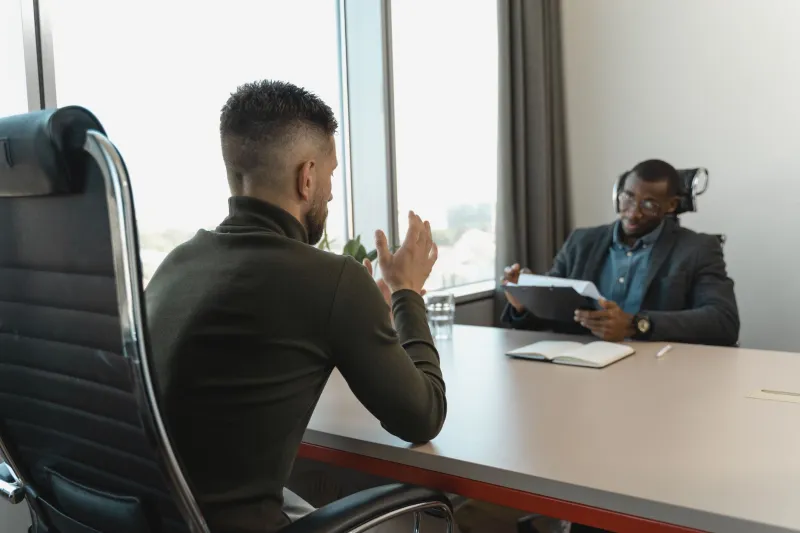
Don't Just Agree: How Pushing Back in Interviews Actually Wins the Job

There's a version of the "perfect interview" that most candidates rehearse in their heads. You walk in confident, you answer every question cleanly, you smile at the right moments, and you never — not once — make the interviewer feel uncomfortable. You leave having agreed with everything, offended no one, and said absolutely nothing that could be used against you.
And then you don't get the job.
Here's the uncomfortable truth: the candidate who politely challenged the interviewer's premise, redirected a flawed question, or respectfully said "I actually see that differently" — that person is still in the conversation. You're not.
Welcome to the interruption advantage.
The Nodding Problem
Interviewers are human. They get bored. They run the same script with fifteen candidates in a week, and after a while, the responses blur together like a bad playlist on shuffle. Candidates who validate every assumption, agree with every framing, and treat the interviewer's word as gospel don't register as impressive — they register as forgettable.
The psychological term for what's happening here is impression homogeneity. When everyone behaves the same way, the brain stops distinguishing between them. You become part of the noise.
Passive agreeableness isn't just neutral — it actively works against you. It reads as a lack of conviction. Hiring managers, especially at startups and fast-moving companies, aren't looking for someone who will nod through every bad idea in a sprint planning meeting. They're looking for someone who will catch the flaw before it ships.
If you can't demonstrate that instinct in a 45-minute conversation, why would they believe you'd do it on the job?
What Strategic Pushback Actually Looks Like
Let's be clear: this isn't about being combative, contrarian, or difficult. Nobody's suggesting you walk into a final-round interview and start an argument about the company's go-to-market strategy.
Strategic pushback is precise, grounded, and delivered with respect. It sounds like:
- "That's an interesting framing — I've actually seen it work differently in my experience. Can I walk you through what I observed?"
- "I want to make sure I'm answering the right question here. Are you asking about X, or is the real concern Y?"
- "I might push back gently on that assumption — here's why I think the data tells a slightly different story."
Notice what these responses do. They signal that you're listening critically, not just waiting for your turn to speak. They demonstrate that you're capable of independent thought without being reckless about it. And they make the interviewer actually think — which means they're now engaged with you in a way they weren't ten minutes ago.
That engagement is the whole game.
The Neuroscience of Being Memorable
Memory research consistently shows that we recall things that surprise us, challenge our expectations, or create a mild emotional response. Psychologists call this the von Restorff effect — the tendency to remember items that stand out from their surroundings.
In an interview context, every candidate who agrees with everything is background noise. The candidate who respectfully challenges a premise is a pattern interrupt. They break the script. And the brain, almost involuntarily, pays more attention.
This isn't manipulation — it's just understanding how human cognition works and using it to your advantage. InterviewJam exists for exactly this reason: great conversations don't happen when one person talks and the other performs compliance. They happen when two people actually engage.
Real Dynamics, Real Outcomes
Consider a common scenario in tech hiring: a senior product manager candidate sits across from a VP who casually mentions that their team measures success primarily through feature velocity. The passive candidate notes it, maybe files it away as a culture red flag, and keeps moving.
The candidate with the interruption advantage pauses and says, "That's something I'd love to dig into a little — in my last role, we found that velocity without outcome tracking was actually creating churn downstream. Is that a tension your team has run into?"
Two things just happened. First, the candidate demonstrated genuine domain expertise and critical thinking in real time. Second, they turned a one-sided interrogation into an actual conversation — one where the VP is now thinking out loud, potentially reconsidering their own framing, and associating that intellectual stimulation with the person sitting in front of them.
That candidate gets a callback. The one who nodded gets a polite rejection email three weeks later.
Knowing When to Push — and When to Let It Go
The skill here isn't just whether to push back. It's when.
Not every interviewer statement is worth challenging. Some things are genuinely informational. Some questions are testing your response to ambiguity, not your willingness to debate. Reading the room matters.
A few guidelines that hold up in practice:
Push back on assumptions, not facts. If an interviewer says something that's clearly wrong about your own experience or about a domain where you have genuine expertise, that's fair game. Don't contradict them on things that are verifiable and outside your lane.
Redirect, don't reject. Instead of saying "that's not the right question," say "I want to make sure I'm giving you the most useful answer — can I reframe this slightly?" You're not dismissing them; you're collaborating.
Match energy to stakes. Early-stage culture fit conversations have more room for intellectual sparring than a technical assessment with a defined rubric. Calibrate accordingly.
Watch for invitation signals. Some interviewers explicitly want debate — they'll say things like "play devil's advocate" or "what would you do differently." That's your green light to go further.
The Confidence Signal You're Not Sending Enough
At its core, the interruption advantage is a confidence signal. And confidence — not arrogance, not aggression, but genuine intellectual self-assurance — is one of the most coveted and underdelivered traits in the interview process.
Agreeable candidates are a known quantity. They're easy to manage in the short term and often disappointing in the long run. The candidate who pushed back once, thoughtfully and with evidence, just showed you something much more valuable: they have a point of view, they're willing to defend it, and they won't just rubber-stamp whatever the room decides.
That's not a risk. That's exactly who you want on your team.
So next time you're in the room and something doesn't sit right — a flawed assumption, a misleading framing, a question that misses the real issue — don't swallow it. Say something. Respectfully, precisely, and with confidence.
Because the candidates who get remembered aren't the ones who performed agreement. They're the ones who showed up.