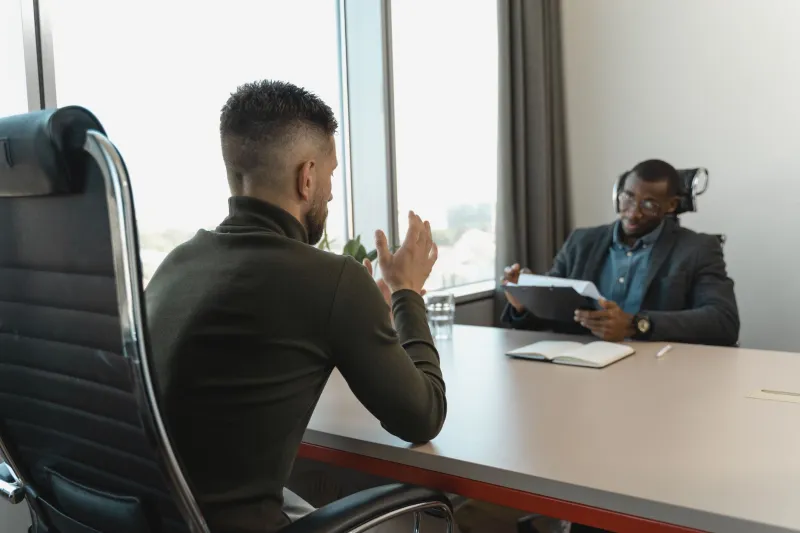
Own Your Failures Before Someone Else Does: Why Flawed Candidates Get the Callback

There's a version of interview prep that's been sold to candidates for decades. Polish everything. Spin every weakness into a strength. Never let them see you sweat — and absolutely never let them see you fail. Clean narrative, confident delivery, no cracks in the armor.
Here's the problem: it doesn't work the way you think it does.
Hiring managers — especially the ones at tech-forward companies, startups, and high-growth teams — have gotten very good at detecting the rehearsed flawlessness. And when they detect it, they don't trust it. The candidate who walks in with a perfectly curated story of unbroken success doesn't read as exceptional. They read as a liability.
The Trust Math Nobody Taught You
There's a psychological principle at work here that researchers call the Pratfall Effect. First documented by social psychologist Elliot Aronson in the 1960s, it describes how a perceived competent person actually becomes more likable and trustworthy after revealing a flaw or making a mistake. The imperfection makes them feel real. It signals self-awareness. It communicates that they're not performing — they're just telling you the truth.
In an interview context, that dynamic plays out in a pretty specific way. When a candidate describes a genuine professional failure — a project that went sideways, a team conflict they handled poorly, a product launch that missed the mark — and then walks through what they actually learned from it, something shifts in the room. The interviewer stops evaluating and starts connecting.
That's the moment a conversation becomes a hire.
What Recruiters Are Actually Listening For
Seasoned recruiters will tell you that the most revealing part of any interview isn't the highlight reel. It's the moment a candidate is asked to talk about something that went wrong.
The candidates who fumble that question — who pivot to vague non-answers, who describe "failures" that are transparently humble-brags, who rush through the story without sitting with what it actually cost them — those are the ones who raise flags. Not because failure is disqualifying, but because the inability to own it signals something deeper: a fragile ego, a low tolerance for accountability, or a lack of genuine self-reflection.
Contrast that with the candidate who says something like, "I made a call that cost us three weeks of engineering time and I didn't catch it fast enough. Here's what I missed, here's what I changed about how I work, and here's what that situation taught me about making decisions under pressure." That answer is worth ten polished success stories.
Recruiters call this mistake ownership, and at a growing number of tech companies, it's become an informal signal for growth mindset — a trait that correlates strongly with long-term performance, especially in fast-moving environments where conditions change faster than any playbook can keep up.
The Startup Lens
This dynamic is especially pronounced in startup and scale-up culture, where the mythology of "fail fast, learn faster" isn't just a poster on the wall — it's an operational philosophy. Founders and early-stage hiring managers aren't looking for candidates who've never stumbled. They're looking for people who've stumbled, figured out why, and gotten back up with better instincts.
In that context, a candidate who presents a flawless track record doesn't inspire confidence. It raises a different kind of question: Have they ever been in a situation hard enough to actually test them?
Startups run on resourcefulness, adaptability, and the willingness to move through uncertainty. A candidate who can narrate failure — who can describe the moment things broke down and articulate the specific decisions that led there — is demonstrating exactly the kind of analytical self-awareness those environments require.
How to Talk About Failure Without Tanking the Interview
None of this means you should walk into your next interview and lead with a disaster story. There's a craft to this. The candidates who leverage vulnerability effectively aren't just confessing — they're contextualizing.
Here's what separates the effective failure story from the one that backfires:
Specificity over vagueness. "I once struggled with communication" is forgettable. "I misread the urgency of a client's concerns and it cost us the renewal" is a real story with real stakes.
Causality over victimhood. The best failure narratives explain why something went wrong and take clear ownership of the candidate's role in it. Blaming circumstances, teammates, or bad luck signals exactly the opposite of accountability.
The pivot matters. What changed? What did you actually do differently afterward? The learning arc is the whole point. Without it, you're just recounting a bad day.
Calibrate to the role. A massive, organization-wide failure might not be the right story for an entry-level position. Match the scale of the failure to the scope of the job you're interviewing for.
The Confidence Hiding in Candor
Here's the counterintuitive core of all this: talking openly about your failures isn't a display of weakness. It's a display of confidence. It says, I've looked at my worst moments clearly enough to describe them, and I'm not afraid of what you'll think when I do.
That's a rare quality. Most people spend enormous energy managing how they're perceived — softening edges, pre-emptively defending, hedging everything. The candidate who drops that performance and just tells you what actually happened? They stand out immediately.
At InterviewJam, we talk a lot about what makes a great conversation — and the best ones aren't built on polish. They're built on honesty. The interviews that end in offers are usually the ones where something real got said.
Your failures aren't the thing standing between you and the job. How you talk about them might be the thing that gets you hired.