Shut Up and Ask Something: How Candidates Who Probe Get the Offer
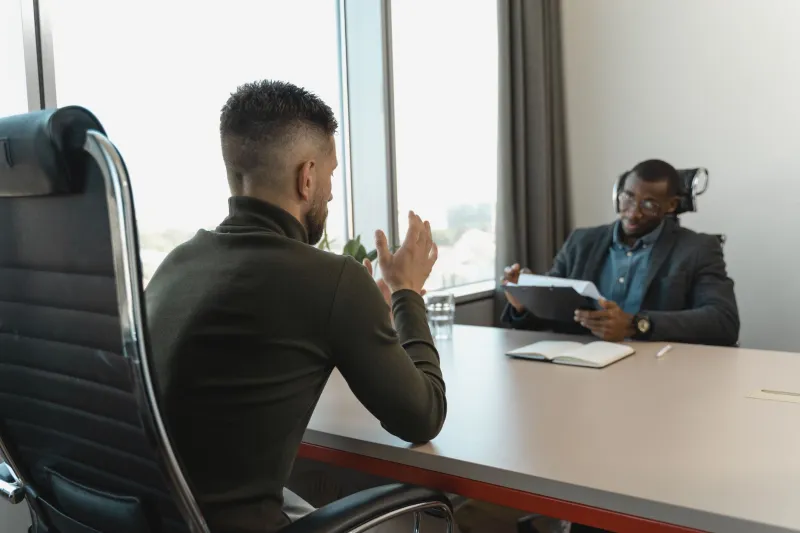
There's a moment near the end of almost every interview that most candidates completely waste.
The interviewer leans back, glances at the clock, and says, "So — do you have any questions for us?"
And the candidate, exhausted from performing for the last 45 minutes, says something like: "I think you've covered everything, honestly. I'm really excited about the role."
Smile. Handshake. Gone.
Here's the thing: that moment? It wasn't a formality. It was a test. And they just failed it.
The Silence Problem Nobody Talks About
Most hiring guides spend their energy coaching candidates on how to answer questions — the STAR method, how to spin weaknesses, how to talk about salary without flinching. Almost none of them spend serious time on the flip side: how to ask questions, and why doing it well might matter more than any single answer you give.
Research in organizational psychology consistently shows that candidates who engage interviewers in genuine back-and-forth dialogue are rated as more intelligent, more curious, and — critically — a better cultural fit. A 2021 study published in the Journal of Applied Psychology found that interviewers rated candidates significantly higher on perceived competence when those candidates asked follow-up questions that demonstrated they'd actually been listening.
Not softball questions. Not "What does a typical day look like?" Substantive questions. Ones that signal a real brain working in real time.
And yet, the vast majority of candidates go quiet. Why?
Fear Is Running the Show
The psychology here isn't complicated, but it is worth naming.
Candidates stay silent because asking questions feels risky. What if the question sounds dumb? What if it reveals a gap in knowledge? What if the interviewer takes it the wrong way?
This is threat-avoidance logic, and it makes complete sense in the moment — and terrible sense strategically. Because from the interviewer's side of the table, silence doesn't read as safe. It reads as disengaged. Or worse, uninterested.
Hiring managers at fast-moving companies — your Series A startups in Austin, your scrappy marketing agencies in Chicago, your engineering teams in Seattle — aren't just looking for someone who can do the job. They're looking for someone who cares enough to be curious about it. Someone who will push back in a sprint meeting. Someone who will ask why before they start executing.
A candidate who sits quietly and answers questions on cue doesn't signal that. A candidate who leans in and says, "I noticed you mentioned the team is rebuilding trust after a difficult product launch — how is leadership thinking about that going into Q3?" — that candidate just told you everything about how they operate.
What Good Questions Actually Signal
Let's break down what's really happening when a candidate asks a sharp question.
Intelligence in action. Anyone can rehearse answers. Formulating a relevant question in real time — one that connects something the interviewer said ten minutes ago to a broader strategic concern — requires active listening and synthesis. That's a cognitive skill. Interviewers notice it, often without consciously recognizing why they're impressed.
Genuine interest, not performed enthusiasm. There's a huge difference between a candidate who says "I'm so passionate about this company" and one who asks "Your last two product hires came from agency backgrounds — is that intentional, or is the team actively trying to diversify that perspective?" The second candidate has done their homework and is thinking critically. That's not enthusiasm. That's investment.
Mutual evaluation. Here's the mindset shift that separates candidates who ace interviews from those who merely survive them: the best candidates treat interviews as a two-way assessment. They're not just hoping to get picked — they're deciding whether this is the right place for them. That posture comes through. And interviewers, almost universally, find it attractive rather than off-putting.
The Questions That Actually Land
Not all questions are created equal. "What's the culture like here?" is technically a question, but it's also completely forgettable and vague enough that any interviewer can answer it with PR-approved fluff.
The questions that stick tend to have a few things in common:
- They reference something specific from the conversation
- They touch on tension, challenge, or uncertainty — not just the rosy stuff
- They're forward-looking in a way that implies the candidate sees themselves in the role
Some examples that work in practice:
"You mentioned the team has been growing quickly — what's been the hardest part of maintaining alignment as that's happened?"
"How does this role interact with the product team when there's a disagreement on priorities?"
"What would make someone unsuccessful in this role, even if they had strong technical skills?"
That last one is particularly effective. It's a little uncomfortable, it requires the interviewer to be honest, and it signals that the candidate is thinking about fit in a real, unsentimental way.
The Interviewer's Unconscious Bias
Here's where it gets interesting from a psychological standpoint.
Interviewers don't just prefer candidates who ask good questions — they often can't explain why they prefer them. The preference shows up in post-interview evaluations as things like "strong communicator" or "seemed really sharp" or "I could see them fitting in with the team." What's actually happening is that the candidate created a memorable interaction. They turned a transactional Q&A into something that felt more like a real conversation.
And memory is everything in hiring. When a recruiter is comparing four candidates at the end of a long Tuesday, the one who made the conversation feel like a dialogue is the one who stands out. The others blur together.
This is exactly what InterviewJam was built around — the idea that the best hiring decisions come from great conversations, not great performances. The candidates who understand that instinctively are the ones who keep getting offers.
Make It a Conversation, Not a Ceremony
If you're prepping for an interview, here's the most useful reframe you can make: stop thinking of it as a test you're taking and start thinking of it as a conversation you're co-creating.
That doesn't mean turning it into a debate or interrogating the hiring manager. It means staying curious. It means listening well enough to respond to what's actually being said, not just what you prepared for. It means having three or four real questions ready — ones you actually want answered — and being willing to build on the conversation as it evolves.
The candidates who do this aren't just more likable. They're demonstrating, in real time, exactly the kind of thinking that most companies are desperately trying to hire for.
So the next time someone says "Do you have any questions for us?" — don't smile and say you're good.
Ask something worth remembering.